For years, the customer journey started with a simple action: searching on Google.
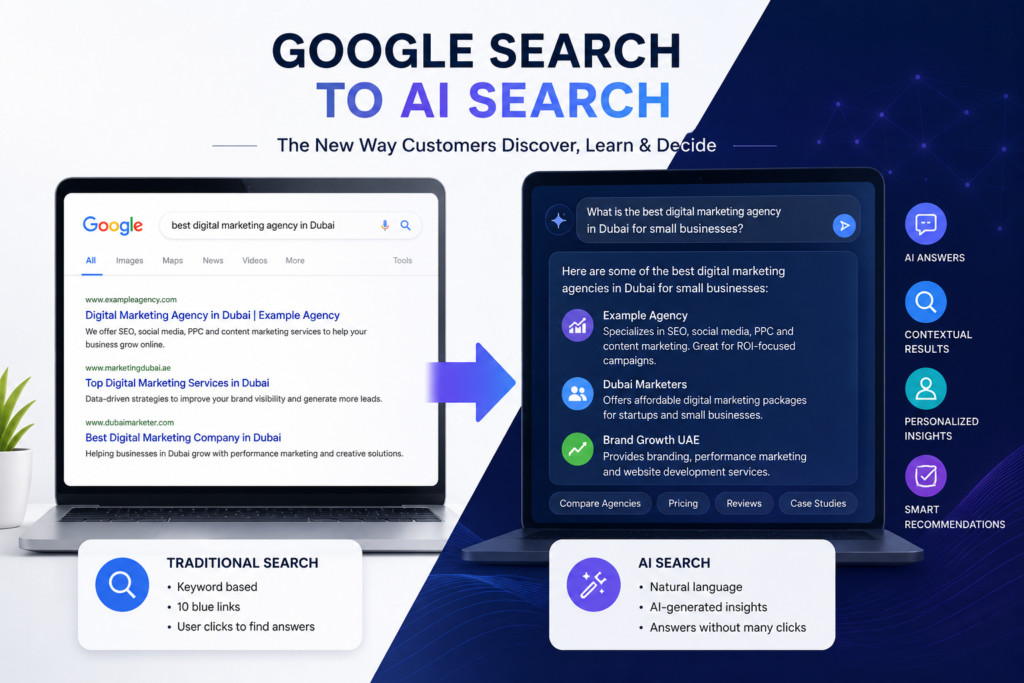
A customer had a question, typed a few keywords into the search bar, looked through the results, clicked a website, compared options, and eventually made a decision.
That journey is changing. how it chnage from Google search to AI search
With AI-powered search becoming part of everyday digital experiences, customers can now ask more detailed questions, receive conversational answers, compare options, discover brands, and continue researching without necessarily visiting multiple websites.
This doesn’t mean Google Search is disappearing.
It means the way people discover information is evolving.
For businesses and marketers, this creates a new challenge: how do you make sure your brand is visible throughout this changing customer journey?
The Traditional Customer Journey
The traditional search journey was relatively straightforward:
Search → Click → Website → Research → Decision → Conversion
For example, someone looking for a digital marketing service in Dubai might search:
They would receive search results, visit several websites, compare services, check reviews, and contact a business.
SEO played a major role in this process because ranking prominently could generate valuable website traffic.
But today’s search behaviour can be much more complex.
The Rise of AI Search
AI-powered search is changing how users interact with information.
Instead of entering short keyword phrases, people can ask complete questions and have a conversation with a search system.
For example, instead of searching:
a user might ask:
“I run a small e-commerce business in Dubai. What digital marketing strategy should I use to increase online sales with a limited budget?”
That’s a completely different type of search.
The user isn’t simply looking for a website.
They’re looking for guidance.
This means marketers need to understand the context behind searches rather than focusing only on individual keywords.
Search Intent Is Becoming More Important
Keywords still matter.
But search intent matters even more.
Consider these three searches:
“SEO Dubai”
The user may be looking for an SEO service.
“How does SEO work?”
The user is looking for information.
“Best SEO specialist in Dubai for an e-commerce business“
The user may be close to making a purchasing decision.
Each query represents a different stage of the customer journey.
A strong SEO strategy should create content for all of these stages.
The New AI-Driven Customer Journey
The modern customer journey can look more like:
Question → AI Search → Discovery → Comparison → Social Proof → Brand Search → Website → Conversion
And sometimes the website isn’t even the first destination.
A customer might discover a business through an AI-generated answer, then look at its Instagram profile, read Google reviews, watch a YouTube video, and finally visit the website.
This makes digital marketing more interconnected than ever.
SEO can no longer operate completely separately from social media, content marketing, branding, and customer reviews.
AI Search Doesn’t Eliminate SEO
One of the biggest misconceptions about AI search is that traditional SEO is becoming irrelevant.
That’s not necessarily true.
Technical SEO, website structure, relevant content, internal linking, backlinks, page experience, and keyword research remain important foundations.
But SEO is expanding.
Modern SEO increasingly involves creating content that is:
- Helpful
- Relevant
- Easy to understand
- Well structured
- Trustworthy
- Based on real experience
- Focused on user intent
The goal isn’t simply to rank a webpage.
The goal is to make your brand discoverable and trustworthy across search experiences.
Why Content Quality Matters More
AI can generate content extremely quickly.
That means the internet is becoming increasingly crowded with information.
Simply publishing more articles isn’t necessarily a competitive advantage anymore.
Brands need to provide something valuable.
That could be:
- Original research
- Personal experience
- Expert opinions
- Case studies
- Practical examples
- Unique data
- Customer experiences
- Helpful guides
For example, instead of writing a generic article titled “What Is SEO?”, a Dubai-based marketer could create:
“How Local SEO Can Help Small Businesses in Dubai Get More Customers.”
The second topic is more specific, more useful, and more connected to a real audience.
The Importance of Brand Authority
AI search also makes brand authority increasingly important.
Imagine two businesses offering similar services.
One has a website with a few generic pages.
The other has:
- Detailed educational articles
- Customer reviews
- Active social media profiles
- Helpful videos
- Industry mentions
- Case studies
- Consistent branding
Which one looks more trustworthy?
The second business has created a broader digital footprint.
This is why marketers should think about digital authority, not just website rankings.
Social Media Is Part of Search
Search doesn’t only happen on Google anymore.
People increasingly use platforms such as Instagram, TikTok, YouTube, Pinterest, and LinkedIn to discover information, products, creators, and businesses.
Someone looking for a restaurant might search Instagram.
Someone looking for a product review might search YouTube.
Someone looking for inspiration might search Pinterest.
Someone researching a professional might look at LinkedIn.
This means businesses need to think about search visibility across platforms.
Your content should be discoverable wherever your audience is looking.
What a Digital Marketing Specialist in Dubai Needs to Understand
For a digital marketing specialist in Dubai, the role is no longer limited to managing advertisements or improving Google rankings.
A modern strategy needs to connect several areas:
SEO + AI Search + Content Marketing + Social Media + Local SEO + Branding + Analytics
For example, a Dubai e-commerce business could use SEO articles to capture informational searches, product pages for transactional searches, Instagram Reels for discovery, customer reviews for trust, and retargeting campaigns for conversion.
Each channel supports a different part of the customer journey.
That’s where strategic digital marketing becomes more valuable than simply posting content.
How Businesses Can Prepare for AI Search
Businesses don’t need to completely rebuild their marketing strategy overnight.
Instead, start with the fundamentals.
1. Understand your audience
Find out what your customers actually ask before purchasing.
2. Create useful content
Answer those questions clearly and genuinely.
3. Build topical authority
Create multiple useful resources around your core services or products.
4. Strengthen local SEO
For Dubai businesses, make sure your business information, reviews, website, and local presence are consistent.
5. Build a recognizable brand
Don’t rely entirely on search rankings. Create a brand people remember.
6. Measure more than traffic
Monitor impressions, engagement, branded searches, leads, conversions, and other meaningful signals.
The Future of the Customer Journey
The customer journey is becoming less linear.
A person might discover your brand on Google, learn about you through Instagram, ask an AI tool for recommendations, read your reviews, watch a video, and then search your brand name directly.
The winning brands will be those that provide a consistent experience across all these touchpoints.
Search is no longer just a gateway to websites.
It is becoming an ecosystem for discovery, research, comparison, and decision-making.
Final Thoughts
The transition from Google Search to AI Search isn’t the end of SEO.
It’s an opportunity to rethink what SEO actually means.
The goal is no longer just to get a customer to click your website.
The bigger goal is to make your business visible, useful, credible, and memorable throughout the customer journey.
For marketers, this means moving from a keyword-first mindset to a customer-first mindset.
Because the future of search won’t simply belong to the businesses that rank highest.
It will belong to the businesses that provide the best answers, build the strongest trust, and remain visible wherever their customers search.