If you’ve felt like AI search & SEO playbook you learned even two years ago suddenly stopped working the way it used to, you’re not imagining things. Search has quietly gone through one of its biggest transformations in over a decade, and 2026 is the year it’s impossible to ignore. AI Overviews, ChatGPT, Perplexity, and Gemini aren’t just “extra” places people search anymore. For a huge chunk of users, they’re becoming the first stop, and sometimes the only stop.
As a digital marketing specialist in Dubai & SEO expert, I’ve watched this shift unfold in real time across client accounts, and honestly, it’s less about panic and more about adapting the fundamentals. Let’s break down what’s actually changing and what it means for your brand.
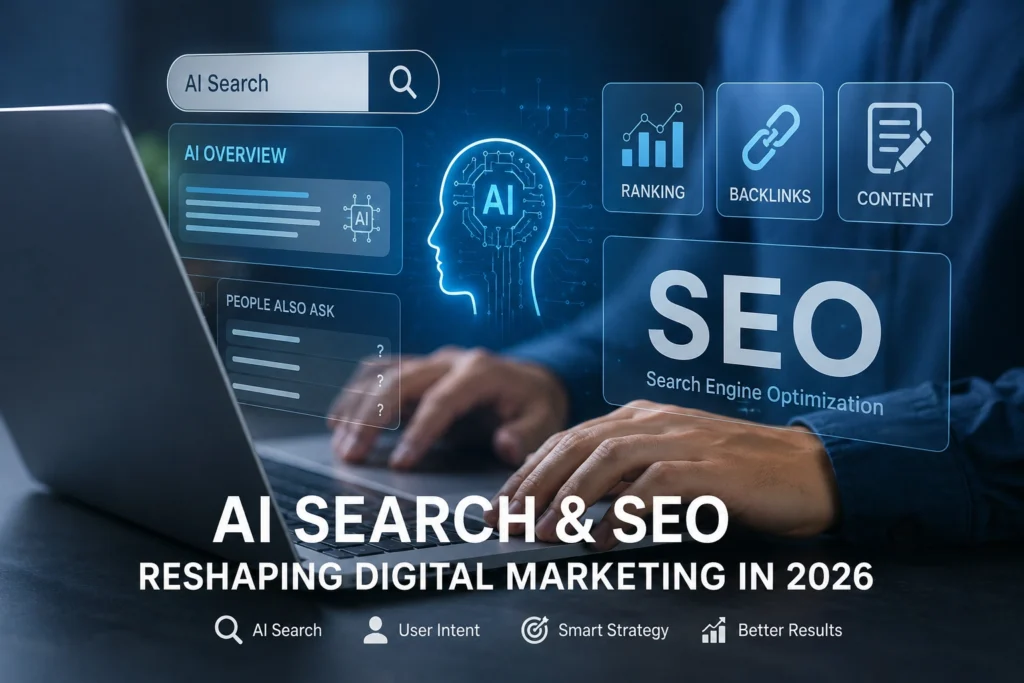
From “Ranking” to “Being the Answer”
Traditional SEO was built around one goal: rank higher than the next website. That’s still relevant, but it’s no longer the whole game. AI-powered search engines don’t hand users a list of ten blue links to click through. They synthesize an answer, often citing just a handful of sources, and present it directly. This means the real competition today isn’t just for position one, it’s for being the source an AI system trusts enough to quote.
That’s where Generative Engine Optimization (GEO) and Answer Engine Optimization (AEO) come in. These aren’t buzzwords marketers invented to sound trendy, they’re becoming distinct disciplines with their own strategies, tools, and success metrics. Instead of tracking keyword rankings alone, brands are now watching things like AI citation frequency and share of voice inside generative answers.
Zero-Click Search Is the New Normal
One of the biggest shifts is the rise of zero-click search. More people are getting their questions answered directly on the results page or inside an AI chat window, without ever clicking through to a website. For content creators and businesses, this changes the whole calculation. Visibility now matters even when it doesn’t translate into a website visit, because being mentioned or cited by an AI system still builds brand trust and awareness, even if the click doesn’t happen.
This is uncomfortable for marketers who are used to counting traffic as the ultimate success metric. But brands that adapt are shifting focus toward being present and referenced across every surface where their audience searches, not just chasing clicks.
E-E-A-T Matters More, Not Less
A common misconception is that AI search means content quality matters less. It’s actually the opposite. AI systems are far more selective about what they cite, and they lean heavily on Experience, Expertise, Authoritativeness, and Trustworthiness (E-E-A-T) signals to decide what’s reliable enough to reference. Thin, generic, keyword-stuffed content simply doesn’t make the cut anymore. What works instead is original insight, clear structure, and genuinely useful information that reflects real expertise, exactly the kind of positioning any digital marketing specialist in Dubai & SEO expert should be building into client strategies right now.
What This Means for Your Content Strategy
So what should businesses actually do differently in 2026? A few things stand out:
- Structure content clearly. AI systems favor well-organized information with logical headings, direct answers, and scannable formatting.
- Go deeper on topics, not wider. Building genuine topical authority beats publishing scattered, shallow posts.
- Invest in original data and insights. AI models are more likely to cite content that offers something they can’t find everywhere else.
- Don’t abandon traditional SEO. Technical SEO, schema markup, and solid on-page fundamentals still form the backbone that AI systems crawl and rely on.
- Diversify beyond Google. Optimizing only for Google search is no longer enough when ChatGPT, Perplexity, and Gemini are becoming everyday discovery tools.
The Bottom Line
SEO isn’t dying, it’s expanding. The brands that will win in this new landscape aren’t the ones chasing every algorithm update in panic, but the ones building genuinely trustworthy, well-structured, expert-driven content that works across both traditional search and AI-powered platforms. Whether you’re running an e-commerce brand or a B2B service business, the strategy is the same: earn trust, structure your content well, and show up everywhere your audience is asking questions.
2026 isn’t the end of SEO as we know it. It’s the beginning of a smarter, more integrated approach to being found, one where visibility means being the answer, not just the link.