In 2026, attention has become one of the most valuable assets in digital marketing.
Every day, people scroll through Instagram Reels, TikTok videos, YouTube Shorts, advertisements, brand posts, emails, and endless streams of content. For businesses, the challenge is no longer simply creating content. The real challenge is getting someone to stop scrolling long enough to notice it.
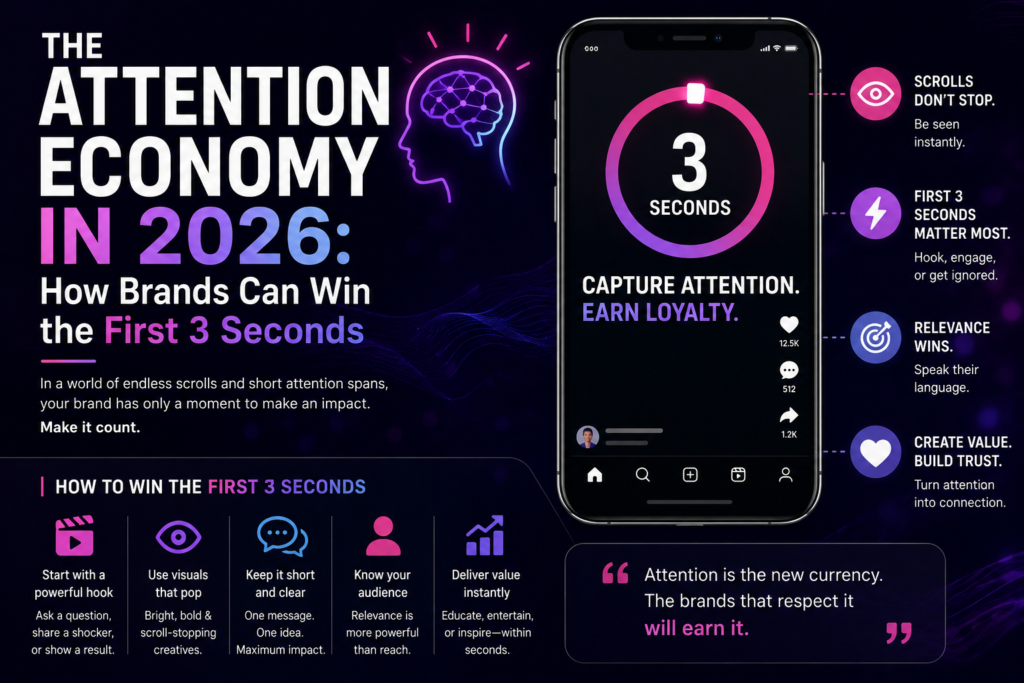
For a Digital Marketing Specialist in Dubai, this is particularly important. Dubai is one of the world’s most competitive digital markets, with businesses constantly competing for the attention of consumers who are exposed to hundreds of messages every day.
So how can brands stand out?
The answer starts with understanding human attention.
What Is the Attention Economy?
The attention economy is based on a simple idea: people’s attention is limited, while the amount of information competing for that attention continues to grow.
Think about your own social media feed. You might see a restaurant advertisement, a fashion Reel, a business tip, a product review, a meme, and an influencer’s video within a few seconds.
You don’t consciously analyze every piece of content.
You simply decide:
Stop or scroll?
That tiny decision is extremely important for marketers.
Research published in 2026 continues to highlight how selective online audiences have become. One recent consumer study found that while people still read online articles, many decide whether something deserves their attention before committing to the full content. Video is also increasingly used as an entry point for discovering information.
This is why the first few seconds of content have become so valuable.
Hook Psychology: Why People Stop Scrolling
A hook is the opening idea, visual, sentence, or moment that gives someone a reason to continue watching.
But a good hook isn’t simply about being loud or dramatic.
It should answer one important question:
“Why should I care?”
For example, imagine a digital marketing Reel.
A weak opening might be:
“Hi everyone, today I’m going to talk about Instagram marketing.”
There is nothing wrong with the information, but it doesn’t immediately create curiosity.
A stronger opening could be:
“Your Instagram isn’t growing because of one mistake you’re probably making.”
Now the viewer has a reason to continue.
The hook creates a problem.
The viewer wants to know whether they’re making that mistake.
That’s the psychology behind effective hooks.
Five Hook Styles Marketers Can Use
1. Problem Hook
Start with something your audience struggles with.
“Getting views but no customers?”
This works because the audience immediately recognizes the problem.
2. Curiosity Hook
Create an unanswered question.
“There’s one reason your Reels aren’t converting.”
The viewer naturally wants to discover the answer.
3. Result Hook
Show the outcome first.
“Here’s how we turned a simple product video into a high-engagement Reel.”
The audience sees the destination and wants to understand the journey.
4. Contrarian Hook
Challenge a commonly accepted idea.
“Posting every day isn’t automatically going to grow your Instagram.”
This creates tension between what people believe and what you’re saying.
5. Question Hook
Ask a question that feels personally relevant.
“Would you trust a brand that only talks about itself?”
A good question encourages the viewer to mentally participate.
Short-Form Video Marketing in 2026
Short-form video has become one of the most important formats for digital marketers.
Instagram Reels, TikTok, and YouTube Shorts allow brands to communicate ideas quickly through a combination of visuals, audio, text, storytelling, and emotion.
But successful short-form video isn’t simply about making a video shorter.
It is about making the message faster to understand.
A strong short-form video can follow a simple structure:
HOOK → VALUE → PAYOFF → CTA
For example:
Hook:
“3 Instagram mistakes small businesses should stop making.”
Value:
Explain the three mistakes.
Payoff:
Give practical alternatives.
CTA:
“Save this before planning your next content calendar.”
This approach gives the viewer a reason to stay beyond the opening.
Interestingly, current consumer research suggests that video and written content shouldn’t necessarily be treated as competitors. Short-form video can introduce an idea, while longer articles can provide the deeper explanation.
For marketers, this creates an opportunity to build a content ecosystem rather than relying on one format.
Curiosity Gaps: The Psychology Behind “I Need to Know”
One of the most effective techniques in content marketing is the curiosity gap.
A curiosity gap exists when you give someone enough information to make them interested but leave an important piece unanswered.
For example:
“I changed one thing in my content strategy, and it completely changed how I planned my Reels.”
The audience immediately wonders:
What did you change?
That question creates momentum.
However, there is an important difference between curiosity and clickbait.
Clickbait creates curiosity but fails to deliver.
Good marketing creates curiosity and then rewards it with useful information.
That is how brands can build both attention and trust.
Emotional Triggers in Digital Marketing
People don’t make decisions based purely on information.
Emotion plays an important role in how audiences respond to content.
Different emotions can create different reactions.
Curiosity
“I want to know what happens.”
Surprise
“I didn’t expect that.”
Aspiration
“I want that lifestyle or result.”
Relatability
“That is exactly what I’m experiencing.”
Fear of Missing Out
“Maybe everyone else already knows this.”
Happiness
“That made me feel good.”
Nostalgia
“That reminds me of something.”
Effective digital marketing doesn’t mean manipulating people.
It means understanding what matters to the audience and communicating it in a way that feels meaningful.
For a brand, the strongest emotional content is usually connected to a genuine customer need.
What Makes Content Scroll-Stopping?
Scroll-stopping content doesn’t necessarily require expensive equipment, cinematic editing, or complicated production.
Sometimes a simple idea presented at the right moment can outperform highly polished content.
A strong piece of content often combines:
- A clear opening message
- Strong visual movement
- Relevant information
- Human personality
- A recognizable problem
- Emotional connection
- Good pacing
- A clear payoff
Research and industry analysis in 2026 continue to emphasize the importance of designing the opening moments of social content intentionally rather than relying entirely on trends or posting frequency.
The goal isn’t simply:
“Make people stop.”
It is:
“Make the right people want to keep watching.”
The 3-Second Content Framework
A practical way to think about short-form content is to divide the opening into three stages.
0–1 Second: STOP
Interrupt the scrolling pattern.
Use a strong visual, unexpected movement, bold statement, or immediately recognizable situation.
1–2 Seconds: INTEREST
Give the viewer a reason to stay.
Introduce a problem, question, result, or curiosity gap.
2–3 Seconds: PROMISE
Tell the viewer what they will receive by continuing.
For example:
“Stay until the end and I’ll show you exactly how to fix it.”
The first three seconds shouldn’t feel like a separate trick.
They should naturally lead into the story.
Attention Is Not the Same as Engagement
Getting someone’s attention is only the beginning.
A video can receive thousands of views without generating meaningful business results.
For marketers, the bigger journey is:
Attention → Retention → Engagement → Trust → Action → Conversion
A strong hook earns attention.
Useful content earns retention.
Authenticity builds trust.
A clear call-to-action encourages action.
And a good customer experience helps turn that action into conversion.
This is why digital marketing should never focus only on vanity metrics such as views or impressions.
The real question is:
Did the content create value for the right audience?
What This Means for Digital Marketing in Dubai
Dubai’s digital landscape is highly competitive. Businesses across e-commerce, hospitality, real estate, beauty, fashion, food, technology, and professional services are all competing for consumer attention.
This makes attention-driven content particularly important.
A Digital Marketing Specialist in Dubai needs to think beyond simply creating posts.
The strategy should connect:
SEO + Content Marketing + Social Media + Short-Form Video + Branding + Consumer Psychology
For example, a Dubai-based beauty brand might use:
- SEO articles to capture search demand
- Instagram Reels to create awareness
- UGC to build trust
- Influencer content to expand reach
- Educational posts to demonstrate expertise
- Retargeting ads to encourage conversion
Each channel has a different role, but they can work together as one customer journey.
The Future of the Attention Economy
As AI continues to make content creation faster, the internet will become even more crowded with content.
That means simply producing more posts won’t necessarily give brands an advantage.
The brands that stand out will be the ones that understand people, not just platforms.
AI can help marketers generate ideas.
Analytics can help identify patterns.
Algorithms can help distribute content.
But human psychology determines whether someone actually cares.
The future of digital marketing isn’t about shouting louder.
It’s about communicating faster, smarter, and more meaningfully.
Final Thoughts
In the attention economy, the first three seconds can determine whether someone watches your content or scrolls past it.
But winning attention shouldn’t be the ultimate goal.
The real goal is to earn attention, deliver value, build trust, and create a reason for the audience to come back.
For marketers in 2026, the winning formula is not simply:
Hook → Views
It is:
Hook → Attention → Value → Trust → Action
Because the best content doesn’t just stop the scroll.
It makes people want to stay.